
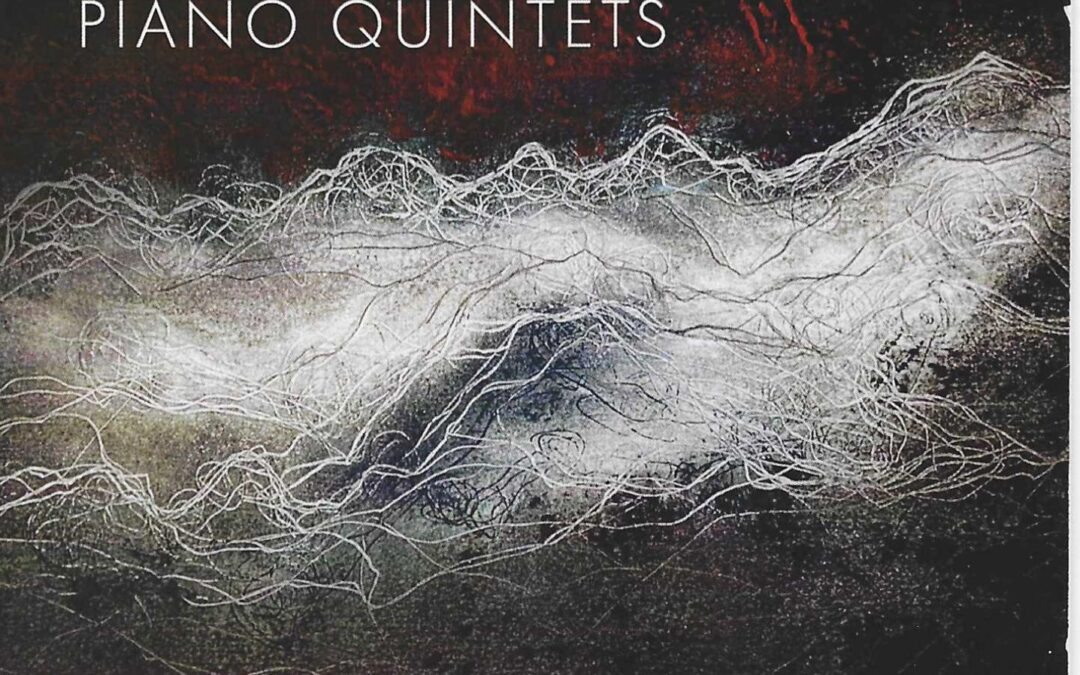
Roderick Chadwick piano
Kreutzer Quartet
MÉTIER RECORDS mex 77141
Jim Aitchison is a composer known for his musical responses to visual art, and he is a visual artist in his own right.
Aitchison’s first piano quintet, Margarete, has its relationship to Anselm Kiefer’s 1981 painting of the same name. The composer states that this is regarded as a ‘pivotal work in Kiefer’s decades-long investigation of postwar German identity. It belongs to a sequence of works produced by the artist in the late 1970s and early 1980s responding to Paul Celan’s poem Todesfuge and its two contrasting central figures: the golden-haired Margarete, and the ashen-haired Shulamith. I chose to conceive the music as a response to my own experience of Kiefer’s Margarete and Celan’s Todesfuge.’
The first movement, Prelude and Chorale, juxtapose Wagner’s Tristan motif with Bach’s harmonisation of the Passion Chorale. The motif, with its unresolved chord, the composer regards as a metaphor for all kinds of idealised earthly longing. The chorale carries an equally potent set of associations. It is presented extremely slowly against which the motif provides a restless contrast.
The second movement uses the symbolism of the magic square, the numbers used to generate a fixed sequence of 34 pitches. The composer admits to a nod towards the serial procedures of the postwar generation of composers, citing Messiaen’s Mode de valeurs et d’intesités as a precedent, but adds, ‘while at the same time deliberately undermining the system, allowing failures and accidents to affect the result.’ The third movement, Dance Fugue, combines an incomplete double fugue and a distorted presentation of Brahms’ Hungarian Dance No.5. The results are very striking and the whole work tends to fascinate because of its constant stream of thematic fragments juxtaposed with passages that may appear to have no thematic content, but where it is heavily disguised.
The second piano quintet is described by the composer as being ‘concerned with emergence and change of that which emerges.’ He describes a visit to a large subterranean chamber beneath the Tremenheere Sculpture Park which made him completely ‘reconsider how I related to light and darkness, and trees, water, and sky that inhabited the space around me at Tremenheere.’ When considering the appropriate musical device to express a state of perpetual emergence and change and the composer lighted upon canon. Specifically, Brahms’ enigma or puzzle canon Mir Lächelt kein Frühling. This dominates the second part of the quintet; the canon having been exposed in the Prelude which opens Part 1, with Part 2 being what the composer entitles ‘responses’ to it.
These are both thought-provoking compositions and while the musical idiom is not an easy one, the listener’s attention is held by the almost kaleidoscopic progress of the music. The performances are completely committed and convincing.
Review by Martyn Strachan