
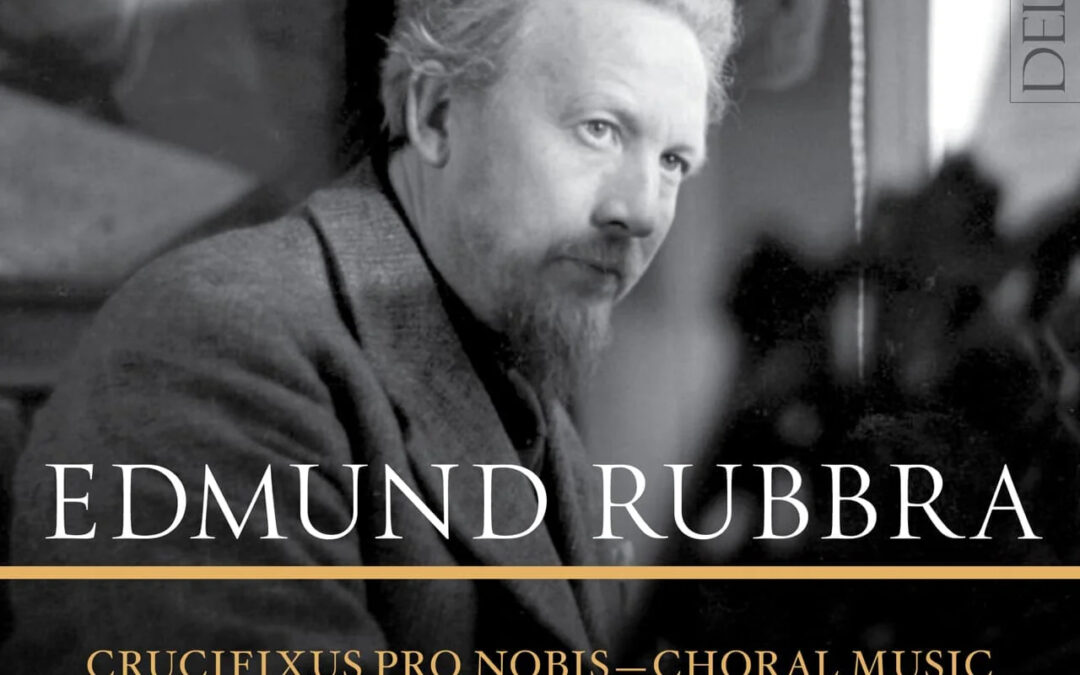
The Chapel Choir of Merton College, Oxford
Benjamin Nicholas conductor
François Cloete and Owen Chann organ
DELPHIAN DCD34332 [58]
Since his death 40 years ago, Edmund Rubbra’s music remains on the outskirts of the repertoire. Much still deserves an airing but this collection includes three first recordings, including the important Cantata di Camera Crucifixus pro nobis.
Rubbra felt close to the more mysitical poets. He sets three poems by Patrick Carey (d.1658) and one by Spenser. The odd scoring is for tenor soloist, the lyrical and passionate voice of Benjamin Hulett, a sixteen-voice choir, flute, violin, cello, harp and organ. The first movement Christ in the Cradle is utterly magical in its scoring.
This leads to Christ in the Garden and then Christ in his Passion the emotional centre of the work culminating in Spenser’s sonnet Most glorious Lord of life composed originally in 1935 for the Five Spenser Sonnets Op 42. Whereas the first three movements are very much the Rubbra of the 1960s, the first reminiscent of passages in his 8th Symphony (1969), this finale though is Rubbra the contrapuntalist of 30 years previous.
Another première follows, the motet The Revival. The text is by another ’mystic’ Henry Vaughan. The other great 17th century poet, John Donne features in Rubbra’s early Five Motets and the choir have chosen the rather dark six-part setting of A Hymn to God the Father and also Eternitie an austere eight-part setting of Herrick’s mystical poem.
The Missa in honorem Sancti Dominici for four-part choir has been recorded several times.It is a very moving work and what I like about this Merton performance is the close attention to detail, ie, dynamic shadings and tempi all in line with the composer’s wishes. Though the tenors and sometimes sopranos may sound strained at points, the overall performance is utterly effective.
Rubbra’s Virgin’s Cradle Hymn of 1922 has an immediate appeal. Published in the Oxford Book of Carols but now is little heard, so this recording will remind listeners of its ethereal beauty.
Rubbra’s Evening Service in Ab is often in the cathedral repertoire although it is an organist’s nightmare with, in the Gloria, triplet quavers in the pedals against typically bell like rising and falling duplet scales in the hands. If well-balanced, as here, it is electrifying and exultant.
The three organ works are distributed between both organists. The Symphonic Prelude is a première recording consisting of about fourteen bars which Rubbra intended to open a new Twelfth Symphony. The Prelude and Fugue on a Theme of Cyril Scott, originally for piano but arranged for organ by Bernard Rose, and the brief twenty bar Meditation written for James Dalton have been recorded before, it is worked around a continuous pedal C. Dalton was an organ scholar at Worcester College, Oxford where Rubbra had been on the staff.
There is an excellent essay, and all texts are provided.
Review by Gary Higginson