
Ulster Orchestra
Charles Peebles conductor
SOMMCD 0713
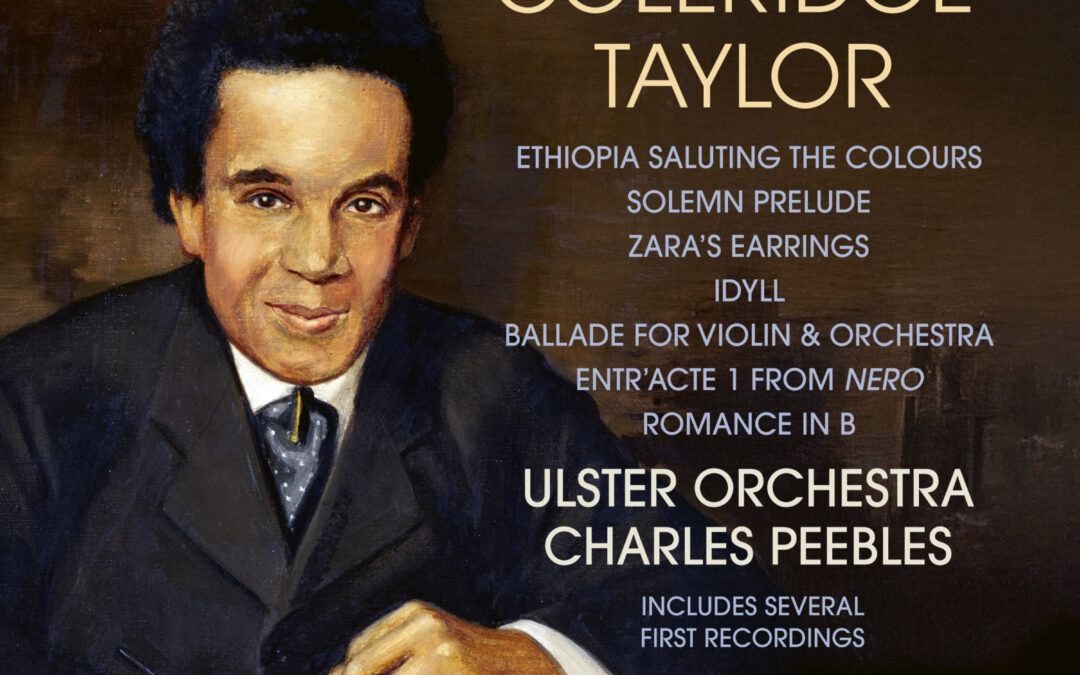
The 150th anniversary of Coleridge-Taylor’s birth has prompted a number of releases of recordings of his music. This one is the more welcome because it includes several works hitherto not committed to disc.
The opening track is the March Ethiopia Saluting the Colours. This was inspired by the Walt Whitman poem which Charles Wood, one of Coleridge-Taylor’s teachers, had set for voice and piano or orchestra. The march depicts General Sherman’s troops as they move from town to village in their liberation of the Carolinas. The elderly slave, Ethiopia, tells a soldier of the cruelty of being forcibly brought to America and how Sherman’s army brings renewed hope. At nine minutes and 50 seconds it seems a little overextended; Elgar’s Pomp and Circumstance Marches tend to last some six to seven minutes. However, the quality of invention is high and the orchestration shows the composer’s usual assured touch.
Another inclusion new to recording is the dramatic scena Zara’s Earrings, which bears the low opus number 7. According to Jeremy Dibble’s excellent notes, this was the composition student’s first encounter with the orchestra. The text is by John Gibson Lockhart, Sir Walter Scott’s biographer, and tells how the daughter of Albuharez, Zara has dropped her earrings, a gift from her Moorish love Muça. This gives an early indication of Coleridge-Taylor’s ability to present drama in musical terms, without necessarily requiring a stage. (From today’s perspective the Hiawatha trilogy seems very much of its time and the enormous appeal it exercised puzzling. However, the composer’s attraction for the exotic touched a chord with the many people whose lives consisted of unremitting toil in bleak and often poor personal circumstances).
Equally welcome is the extract from the Incidental Music to Nero, Op 62. Coleridge-Taylor was strongly attracted to the theatre and music for various productions form a significant part of his output. The culmination was the composition of his opera Thelma, believed for many years to be lost, but recently rediscovered in the British Library by Catherine Carr while researching Coleridge-Taylor’s music for her doctorate.
Another early work is the Ballade for Violin and Orchestra in D minor, Op 4. As a string player himself, the composer’s affinity with the instrument is very clear. At over 15 minutes this is a substantial work which presages the Violin Concerto of 1912, the year of his death.
This is a most enjoyable recording with Rebecca Murphy and Ioana Petcu-Colan distinguishing themselves as soloists in the Scena and Ballade respectively. Everything is played with great conviction and the playing of the Ulster Orchestra and Charles Peebles sympathetic conducting makes this a very desirable acquisition. The recorded sound is also excellent.
Review by Martyn Strachan