
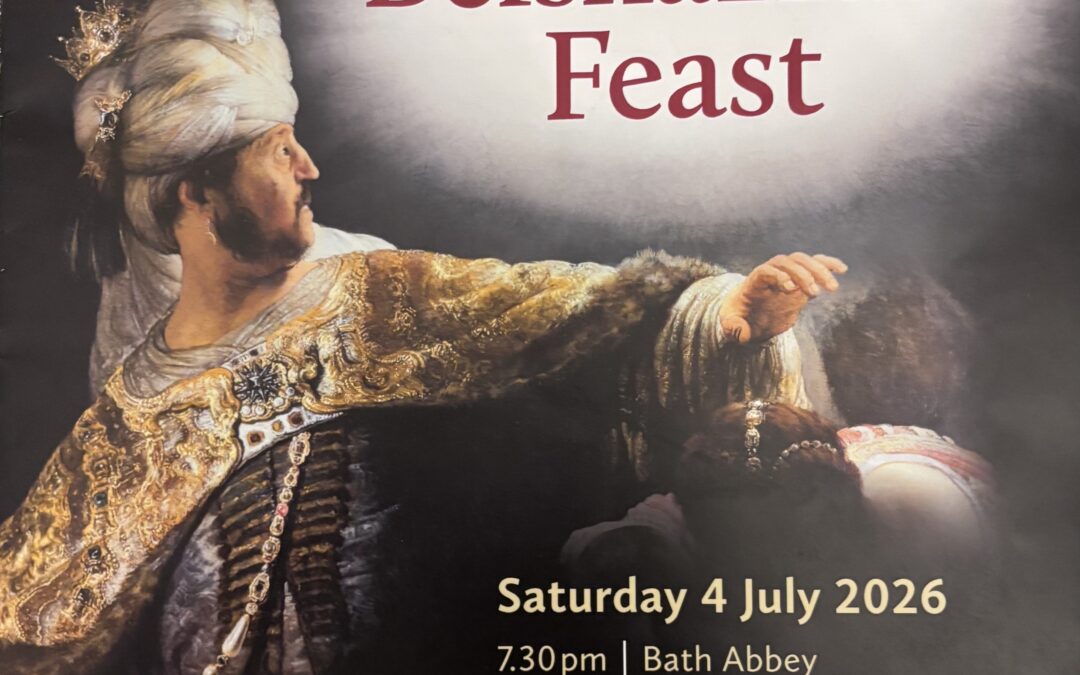
Belshazzar’s Feast
Bath Bach Choir and Bury Bach Choir with Southern Sinfonia
Bath Abbey, 4 July 2026
It may be unusual in a concert review to talk as much about the venue as about the music itself, but on 4 July, here in Bath, some remarkable British music was performed in a remarkable building.
The date itself was interesting, being of course the 250th anniversary of the American Declaration of Independence, to have a concert which could not have been more proudly British. It was also rather strange that the concert description itself made barely a mention of the fact that this was an all-British programme featuring some of the most brilliant music to have been written in these lands.
I should mention that there was one piece by Mendelssohn in the programme – from Elijah. I suppose we can credit him with being a sort of ‘Honorary Brit’ on this occasion thanks to the patronage of Queen Victoria and Prince Albert and the fact that Elijah was commissioned and premiered at the 1846 Birmingham Festival.
The setting for this concert was the extraordinary perpendicular gothic abbey church of St Peter and St Paul standing at the very heart of the city – yet proudly incongruous amid the city’s famous, refined Georgian classical elegance – now even more famous thanks to Netflix’s Bridgerton.
The other thing which was remarkable about this event was its scale: Not just the vast cavernous space of this great Abbey Church, but also the performers with the impressive 140 voices of the joint Bath Bach Choir and the Bury Bach Choir, and the superb 50-strong Southern Sinfonia, at times producing an ear-tingling sonority perfectly capturing the spirit of this great music.
Bath Abbey is one of the great gothic buildings of its age. Begun around 1499, it was inspired by Bishop Oliver King’s vision of angels ascending and descending ladders to heaven – as they still do today, carved in stone on the west front. Construction was halted by Henry VIII as the monasteries were dissolved, and it was not until the 1860s that the famous 78ft-high fan-vaulting was completed by Sir George Gilbert Scott.
Visually, the result is magnificent, but acoustically, with a reverberation time of 4.5 seconds (when empty), the space can bring challenges. In such a resonant space, complex and fast-moving choral and orchestral writing can lose definition, even when the performance itself is disciplined and alert.
Parry’s I Was Glad and Blest Pair of Sirens could well have been written for such a space as this with the imperial majesty of these ceremonial favourites soaring triumphantly above.
Following Parry with Walton was rather like switching to ‘Glorious Technicolor’ with Walton’s dazzling orchestration and rhythmic drive taking us on a rollercoaster ride through the fan vaulting. This was evident in all three works by this composer: the Coronation Te Deum of 1953, the orchestral Crown Imperial of 1937 (with its obvious nod to Elgar in the middle), and the epic Belshazzar’s Feast of 1931.
Conductor Benedict Collins Rice commanded a tight ship throughout with minimal emotion or extraneous movement. This demonstrated his true skill where the hard work had clearly already been done in rehearsal, laying the foundations with immense care and precision for the performance which was to follow. What really struck me was the confidence of the musicians – both orchestral and choral – who followed the conductor’s precise and accurate gestures with an innate understanding of the music and a clear trust and confidence in the ability of the performers – no matter how complex the rhythms or how angular the melodic lines.
After its first performance at the Leeds Festival, Belshazzar’s Feast was dismissed by Sir Thomas Beecham as something unlikely ever to be heard again. Fortunately, he was very wrong and this phenomenally striking work feels as fresh and as contemporary as ever – even after 100 years since its original BBC commission.
The icing on the cake was undoubtedly the star appearance of Willard White in this piece. The unmistakable resonance of this ever-youthful 79-year-old projected effortlessly from his elevated position in the pulpit. Even Bath Abbey’s architecture could not crush the crispness of his diction. He was also the soloist in Mendelssohn’s Lord God of Abraham.
The same programme was performed on 13 June in the Bury Bach Choir’s home of Bury St Edmunds, but with one of the BMS vice-presidents, Roderick Williams, taking the soloist role. I was not present at that performance, but I am sure it would have been equally impressive.
Events such as this are precisely where BMS ought to have more visibility. Such a presence would raise awareness of the richness and diversity of British music, draw people in to discover more of this terrific repertoire, and establish BMS as the organisation at the very centre of ‘Bringing Britain’s Musical Heritage Alive’.
Review by Nicholas Keyworth