
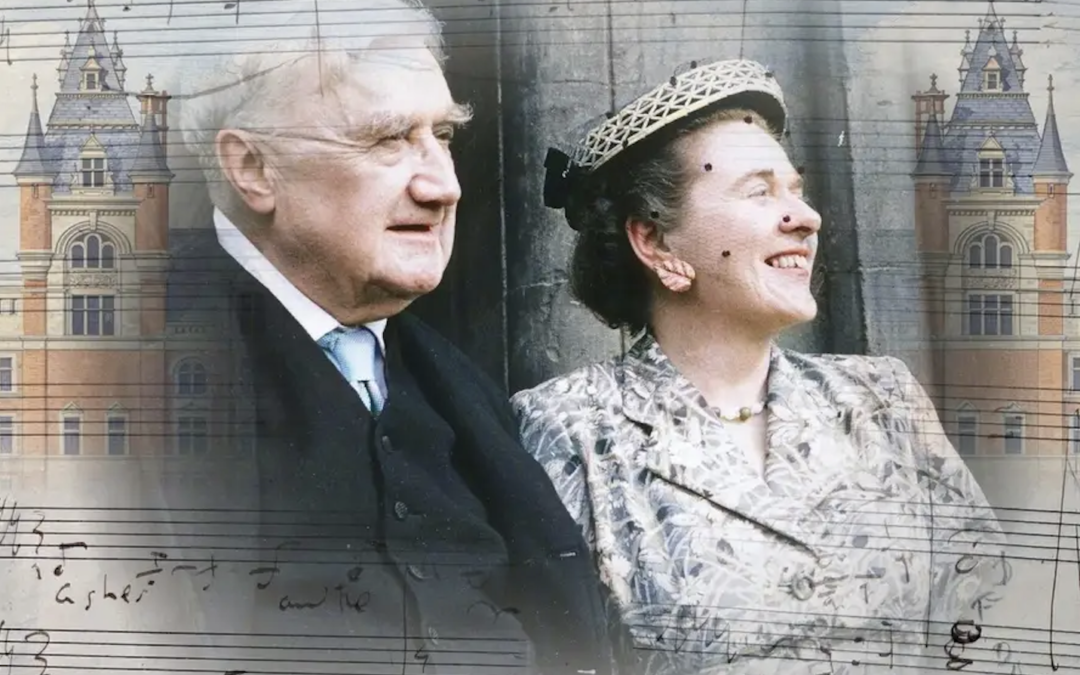
And the women around him
Kitty Whately mezzo
William Vann piano
ALBION ALBCD069
The significance of this excellent issue resides primarily in the items by Maconchy and Grace Williams. Both composers enjoyed close support from RVW, and while this makes for intriguing programme-planning, their music, still unjustly neglected, needs no apologies.
Maconchy is perhaps best known for her instrumental scores, particularly thirteen string quartets, and this fascinating CD leaves one wanting much more. All the songs are highly approachable: the earliest was written when she was only seventeen, and at least two were never performed in her lifetime.
Here are versions of Ophelia’s Song (‘How should I your true love know’), and Come away, Death; a cheerful jeu d’esprit from 1965, King Stephen; settings of Symons, Yeats and Rossetti; and a profound Exequy (funeral rite) to words by Henry King, Bishop of Chichester (d. 1669). The performances are authoritative and considered.
Grace Williams’s plaintive, melancholy cycle Billows of the Sea, written for Helen Watts in 1969, comprises sterner stuff, its three substantial tragic ballads only lightly leavened by Tennyson’s lullaby Sweet and Low. An appropriately woeful encore, balancing The Lowlands of Holland in the cycle, is a setting of Walter Scott’s The Lament of the Border Woman. Its grim narrative is underscored by a triadic funeral march, whose solemn mesmeric pacing is well-judged by Vann. Whatley is also fully convincing here, not least in her Scottish accent.
For all her technical competence, it is a pity that Whately’s accounts of five earlier songs by RVW are slightly disappointing. I would have welcomed a steadier tone and more consistent phrasing in The Sky above the Roof, and more varied colours in the wondrous Four Poems by Fredegond Shove.
I missed much of the pale spirituality of this poet’s gentle philosophical musings, notably in the radiantly ethereal The New Ghost, where, compared to (for example) the lyricism of Ian Partridge, or the poise of Mark Chambers, Whately is vibrant, but earthbound. As a result, The Water Mill is the most successful of this set.
There are no such problems with RVW’s Four Last Songs, whose reflections on human love and devotion suit Whately well, and she gives compelling renditions, charged with sensuality.
The recording is immediate, the duration generous, and the booklet includes photographs and full texts. John Francis’s suggestion of further reading (the 2020 edition of correspondence between Maconchy and Williams) is welcome, although Justin Vickers’ major new symposium on Maconchy (CUP, 2026) places her more fully in context.
Review by Andrew Plant