
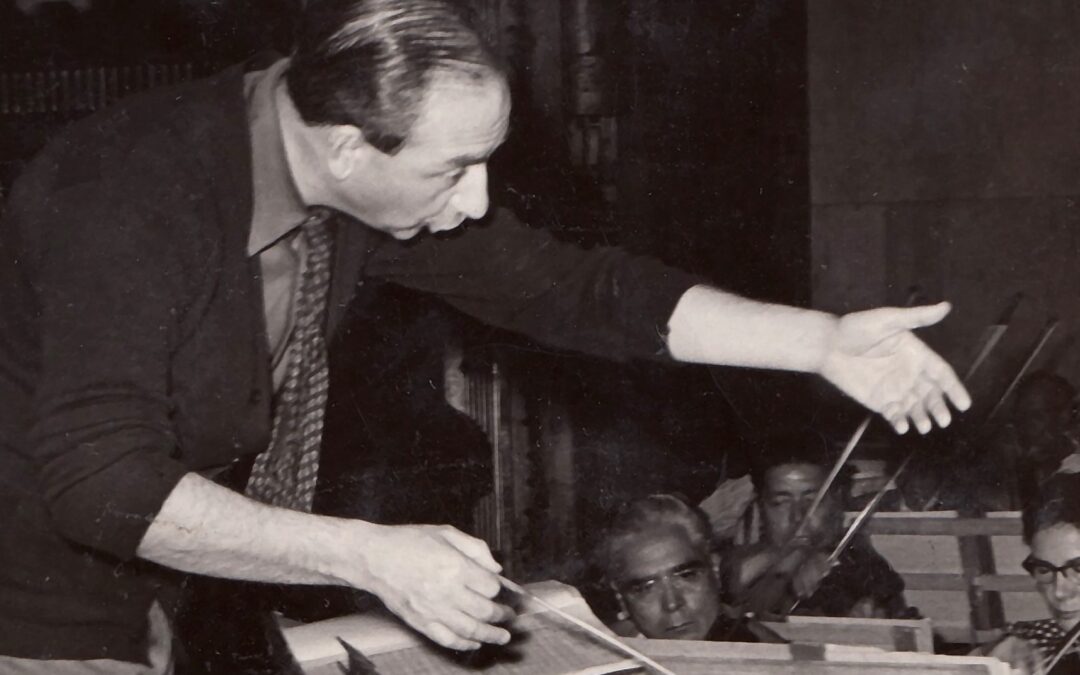
Jack Van Zandt explores Walter Goehr’s contributions to British music
Hitler’s rise to power in early 1930s Germany and his subsequent chokehold on culture created a wave of émigré refugees of accomplished artists and scientists, many of whom were welcomed to the UK where they found a new, safe home and success in their fields that was denied to them by the Nazis. These émigrés had an especially large and important effect on British musical culture that continues to this day.
One of the earliest of these refugees was conductor and composer Walter Goehr (pictured above conducting in the 1950s), who arrived in London from Berlin in early 1933 with his wife, pianist Laelia (née Rivlin), and their infant son, Alexander (Sandy), who would become one of the country’s most important composers later in the century. However, it wasn’t only the Nazis that precipitated the Goehrs’ move to England, but the timely offer of a job from the Gramophone Company to Walter to become their new music director, which he enthusiastically accepted at just the right moment in history.

Walter Goehr was born in Berlin on 28 May 1903 to Jewish parents Julius Goehr (1871-1949) and Thekla Mendelssohn (1874-1932). He was followed on 25 December 1906 by the birth of his brother Rudolph (Rudy), who would also become a successful composer and conductor. The brothers studied music growing up – Walter played the piano and Rudy the violin – and from the age of 18, Walter was able to get work as a theater conductor. He studied with Arnold Schoenberg from 1926 through 1928 at the Prussian Academy of Arts in Berlin in a class which his brother Rudy also joined. Some of the other students in the class at this time were the Spaniard Roberto Gerhard (who would take up residence in Cambridge in 1939), Greek composer Nikos Skalkottas, who was Walter’s best friend in the class, and Schoenberg’s assistant, Austrian musicologist Josef Rufer. Walter remained devoted to Schoenberg throughout his life, and would conduct many performances of his teacher’s works, some of them UK premieres. Schoenberg would also be a very big influence on the compositions that Walter wrote, though he did not adopt his teacher’s serial techniques and his music was more stylistically akin to his friends Kurt Weill and Hanns Eisler and his older colleague Paul Hindemith.
Before, during and after his studies with Schoenberg, Goehr was conducting operettas in Berlin theatres, and in 1925 he was hired by Berlin Radio where he regularly conducted broadcast performances until 1932. He became the music director in the company of the legendary theatre director Erwin Piscator while also composing for theatres and cinemas.
In 1930, at a party hosted by screenwriter and later film director Billy Wilder, Walter was introduced by future Oscar-winning composer Bronislaw Kaper to pianist Laelia Rivlin, who had been born in 1908 in Kyiv where she studied at the conservatory alongside her neighbour Vladimir Horowitz. Arriving in Berlin in 1921 as a refugee from the Russian Revolution and pogroms, Laelia teamed up with her best friend and fellow pianist Rosa Goldstein, forming a popular duo, The Stone Sisters (they called themselves Lil and Peggy Stone), who became well-known entertainers in Germany and other European countries. Walter and Laelia married in 1930, and on 10 August 1932 they welcomed their son Alexander into the world.

Bayer Records.
Walter’s largest scale composition at this time was his 1931 opera, Malpopita, which was specifically written for radio production. The broadcast premiere took place on 29 April 1931, conducted by Erich Kleiber – It would not receive a live staged performance until 2004 in Berlin. He also wrote chamber and orchestral concert music, including a symphony.
With his demonstrated abilities as a crossover artist, Walter was much in demand in Germany before the Nazis brought an end to the Weimar Republic. The offer from the Gramophone Company to relocate to London in 1933 must have seemed extraordinarily propitious to the young conductor and composer, given the rapidly deteriorating circumstances for Jewish musicians in Germany at the time. His first recording session for the company had been in Berlin on 24 January 1932, which may have prompted their offer to Walter to become their music director. The Gramophone Company had been founded in 1909, and its trademark was the famous “His Master’s Voice” (HMV) logo of the dog with its ear cocked towards an old gramophone speaker. It had merged with the UK subsidiary of the USA’s Columbia Records to form EMI Records in 1931.
Goehr sometimes used the professional name of George Walter or G. Walter on popular music recordings, of which he made many, including several recordings with black American bass-baritone Paul Robeson, famously blacklisted in the US in the 1950s for his political and civil rights activism. Over the following years he made recordings with many of the most well-known performers of the era, including Schumann’s Piano Concerto in A Minor, Op. 54, with Myra Hess, and lieder and opera excerpts with Hungarian soprano Gitta Alpár and American tenor Charles Kullman. He made many premiere recordings, including Bizet’s Symphony in C with the LPO in 1937.
In 1940, the Goehrs moved from London to Amersham in Buckinghamshire to escape the Blitz. Their hillside garden overlooked distant London and Sandy Goehr remembered as a child watching the searchlights, Luftwaffe bombing and fires there, as well as seeing “the sky black with German bombers in the evening twilight heading towards the large industrial cities of the North.”
While Walter was making records for the Gramophone Company in the 1930s, he formed a chamber orchestra called the Orchestra Raymonde, which performed mostly light classics that he arranged. The Raymonde had some of the greatest players of the time in it, like Reg Kell (clarinet) and Arthur Cleghorn (flute), who both later emigrated to Hollywood. In forming the Raymonde, Goehr introduced the Hindemith/Stravinsky/Schoenberg mixed chamber ensemble to England, which was completely new at the time. Today we take this idea of such a mix of instruments for granted, but it didn’t exist in England until Walter introduced it, and it only became common after World War II.

Because of his work with the Raymonde that showcased his ability to arrange music for smaller ensembles, Goehr was offered a good job at the BBC doing music for war propaganda programs. Walter arranged music for live broadcast twice a week. He first produced these programs in London, but was later evacuated to the BBC studios in Manchester. He worked on two programs then. One of his great friends was Laurence Gilliam, who was head of BBC Features and Propaganda. They had a program that took place on Wednesdays called “Marching On,” which took news stories and sometimes recordings brought from the correspondents in the field, and dramatized them with sound effects and music that Walter composed, arranged and produced. They also did a weekly program that was beamed into occupied Europe called “The Shadow of the Swastika.”
Goehr made important contributions to the British film industry as both composer and conductor. He had already scored three films before his move to London, including David Golder (1931), legendary French director Julien Duvivier’s first sound film. Walter would be involved in other French films in the 1930s, including contributing music to the score of Princesse Tam-Tam (1935) starring Josephine Baker, the black American singer, dancer, actor and political activist who made her career in France after first performing there in 1927 at age 21.
His first British film was Invitation to the Waltz, a 1935 musical directed by Paul Merzbach, another émigré who had fled Austria for Britain in 1933. This was followed by scores for other films, including The Amateur Gentleman (1936), I Married a Spy (1937) and Dangerous Secrets (1937). His best-known work in film was his score for David Lean’s Great Expectations (1946), which is still held in high regard today. Perhaps even more remarkable at the time, he scored the Hollywood-backed English production of Betrayed (1954), directed by Gottfried Reinhardt, starring Clark Gable, Lana Turner and Victor Mature. Turner caused quite a sensation with moviegoers when in one scene she appeared to sing Johnny Come Home, a song composed by Walter with lyrics by Ronald Millar. Alas it wasn’t Lana Turner’s voice at all, but that of British singer Diana Coupland.
In addition to conducting his own film scores, during the 1940s Goehr would conduct scores for several Powell and Pressburger films that were written by his friend Allan Gray, the professional name used by Polish-born composer and fellow Berlin Schoenberg pupil and émigré Józef Żmigrod. These films included A Canterbury Tale (1944), The Volunteer (1945), I Know Where I’m Going (1945) and A Matter of Life and Death (1946).
In 1945, Goehr was made music director of the BBC Theater Orchestra (now known as the BBC Concert Orchestra), a post he held until 1948. In January 1946, he conducted the orchestra for the premiere performance of Louis MacNeice’s radio play The Dark Tower, with music by Benjamin Britten, on the BBC Home Service. He would conduct other pieces by Britten over the postwar years.
One of Goehr’s best friends was Michael Tippett, who in 1943 invited him to join the Morley College staff to take charge of the orchestra and conduct their concerts, which he would do for the rest of his life. Goehr was very impressed with Tippett’s music and would conduct several of his pieces over the years, including the premieres of the Concerto for Double String Orchestra on 17 July 1943 at Wigmore Hall and A Child of Our Time at the Adelphi Theatre on 19 March 1944. Walter also worked closely with Tippett on the composition and orchestration of his first opera, The Midsummer Marriage (1946-52), as well as fashioning Ritual Dances, the orchestral suite from the opera.

Goehr conducted many important premieres in the Morley concerts, including the first British performance of his editions of Monteverdi’s Vespers and L’incoronazione di Poppea, Britten’s Serenade for Tenor, Horn and Strings (1943) with Peter Pears and Dennis Brain, Mátyás Seiber’s Ulysses (1949) from the James Joyce work, and the first British performance of Mahler’s Sixth Symphony (BBC, 1950). Under the Morley banner, he conducted performances of countless innovative programs that he curated with Tippett, often pairing early music, Baroque and classical works with contemporary pieces such as Stravinsky’s Les Noces.
Goehr also conducted other contemporary works, including the first British performances of Schoenberg’s Four Orchestral Songs, Op. 22, in 1952, Olivier Messiaen’s Turangalîla-symphonie in 1953, and the 1959 world premiere of The Deluge, a cantata by his son Alexander Goehr.
He also made many conducting appearances abroad. In 1952 he directed the first recording of Monteverdi’s L’Incoronazione di Poppea, conducting the Tonhalle-Orchester Zürich in a live stage performance. The LP version, issued in 1954, won a Grand Prix du Disque. In 1959 he traveled with his son to East Berlin to conduct the first complete performance of his friend Hanns Eisler’s Deutsche Sinfonie, with texts by Bertold Brecht, at the Berlin State Opera on 24 April.
Sadly, Walter Goehr’s life came to a tragic end on 4 December 1960 when he died suddenly after conducting a performance of Handel’s Messiah, in Sheffield’s City Hall. He was 57. His legacy lives on today with many of his recordings still available as well as all the films he worked on.
Walter Goehr’s archives are in Berlin’s Akademie der Künste.
Jack Van Zandt (b. 1954) is a Grammy-winning composer of music for concerts, film and TV, and a music educator and writer based in Los Angeles and Ireland. He studied composition in the UK and US with Alexander Goehr, Thea Musgrave, Peter Maxwell Davies and Peter Racine Fricker. His book with Alexander Goehr, Composing a Life: Teachers, Mentors and Models, was published by Carcanet in October 2023. A new CD of his music with soprano Stacey Fraser, A Chaos of Light and Motion, was released by Neuma Recordings in March 2025. His music is published by Composers Edition.